
Hair Tissue Mineral Analysis (HTMA)
A deeper look at the rhythm beneath your symptoms
Your body is always whispering.
Sometimes it does this through anxiety, fatigue, brain fog, stubborn weight changes, hair loss, or hormonal chaos.
HTMA is one of the simplest ways to hear what it’s actually trying to say.
This test looks at the mineral patterns stored in your hair—your body’s long-term memory. Instead of capturing a single moment in time like bloodwork does, HTMA reveals the slow, steady patterns shaping your energy, mood, metabolism, thyroid signaling, and stress response.
HTMA helps us understand:
- Whether your nervous system is stuck in “on” or “off”
- How efficiently your body makes and uses energy
- Your thyroid and adrenal rhythm
- Hidden inflammatory patterns
- Copper, zinc, and iron balance
- Detox pathways (slow, sluggish, or overwhelmed)
- Why certain supplements help—or make you feel worse
- How stress has shaped your mineral patterns over time
The goal isn’t to collect data for data’s sake.
It’s to understand the story your minerals are telling—and then help you restore your natural rhythm.
What’s Included
• HTMA lab test through Trace Elements, Inc.
• Professional review of your mineral patterns
• Report with key pattern highlights
• Supplement recommendations based on TEI mineral balancing
TEI supplements available separately if desired
Discover the Story Your Minerals Are TellingWhy HTMA?
What HTMA Looks At
HTMA measures 35+ essential and toxic elements, including:
- Core minerals: calcium, magnesium, sodium, potassium
- Metabolic & thyroid ratios: calcium/phosphorus, Ca/K, Na/K
- Stress & adrenal patterns: Na/Mg ratio, Na/K patterning
- Mood & hormone influences: copper, zinc, manganese
- Detox & inflammation indicators: sulfur, selenium, chromium
- Heavy metals: lead, mercury, arsenic, aluminum, cadmium
Every pattern is a clue.
When we read the whole map, we get direction—not guesswork.
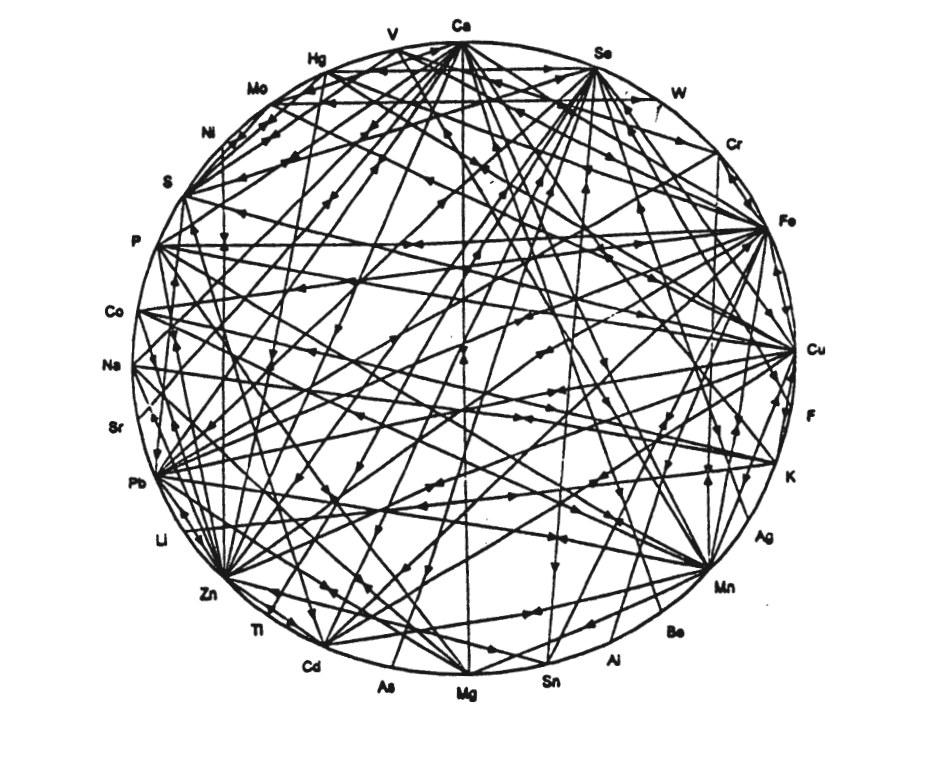
The Mineral Interaction Wheel
This diagram shows something most lab reports miss:
Minerals don’t act alone. They act in relationship.
Each point around the circle represents a mineral measured on your HTMA.
The lines between them show how those minerals influence, oppose, amplify, or buffer one another inside the body.
Calcium doesn’t just “do calcium things.”
It affects magnesium.
It slows potassium.
It changes how thyroid hormone enters cells.
Copper influences iron.
Zinc shapes immune tone and hormone signaling.
Sodium and potassium reflect how your body responds to stress and urgency.
The wheel reminds us that your symptoms don’t come from one deficiency or one excess — they arise from patterns.
Some connections are supportive.
Some are compensatory.
Some are signs the body has been adapting for a long time.
HTMA is the art of learning which lines matter for you.
Why this matters clinically
Two people can have similar lab values and feel completely different.
That’s because:
· one system may be compensating well
· another may be strained
· another may be stuck in long-term adaptation
The interaction wheel helps us see:
· why a supplement helps one person and makes another feel worse
· why “normal labs” can still feel anything but normal
· why timing, balance, and rhythm matter more than chasing numbers
This is also why we don’t treat minerals in isolation.
We read the conversation happening between them.
How this informs your health and wellness
When we interpret your HTMA, we’re not asking:
“What mineral is low?”
We’re asking:
· Where is the system tight?
· Where is it overcompensating?
· Where is it tired of holding things together?
· What does it need to restore rhythm rather than force change?
This wheel is a map of that internal dialogue.
How Does Your Mineral Story Inform Your Health?How to Collect Your Sample
HTMA is simple, painless, and done at home. You’ll receive a collection kit and instructions.
The basic flow:
- Cut a small amount of hair (about 1 teaspoon total)
- Hair must be taken from the root end (newest growth)
- Cut from the back of the head, close to the scalp, in thin snips
- If your hair is very short, beard hair or body hair may be used
The lab only needs the first 1–1.5 inches of growth. Any longer length is trimmed before mailing.
If You Color or Treat Your Hair
Color-treated hair is acceptable. A few guidelines:
- Avoid collecting hair within 4–6 weeks of coloring or bleaching
- If you’ve recently dyed your hair and can’t wait, we may collect from an untreated area underneath, or use beard/body hair instead
The goal is clean, untreated new growth—your most accurate mineral story.
What Happens After Testing
Once your results return, you’ll receive your HTMA report with key pattern highlights and foundational supplement recommendations.
Some people feel clarity just seeing their mineral patterns.
Others want help understanding what it means for their energy, hormones, and overall health.
If you’d like deeper support, interpretation sessions are available to walk through your results and create a personalized plan.
This is for you if:
• You’ve tried “normal labs” but still don’t feel like yourself
• You want a deeper look at stress, energy, and hormone patterns
• You’re ready to understand your body instead of guessing
HTMA is a supportive, educational tool. It does not diagnose disease and is not required for care. It is offered as an optional add-on for patients who want a deeper layer of insight.